Shipping Container Sizes Explained: 10ft, 20ft, 40ft & More (2026 Buyer’s Guide)
Choosing the right shipping container starts with understanding size. Whether you need compact on-site storage, a spacious workspace, or a high-capacity freight unit, the dimensions you pick affect everything from cost to delivery to how you’ll use the container for years to come. This guide breaks down the most common shipping container sizes and helps you decide which one fits your project.
Standard Shipping Container Sizes at a Glance
Most steel shipping containers follow ISO standards, so their widths and heights are consistent while lengths vary. A standard container is 8 feet wide and 8 feet 6 inches tall, while a high cube adds an extra foot of height for more vertical space. Length is where you’ll see the biggest differences, from compact 10ft units up to long 40ft and 45ft containers.
10ft Shipping Containers
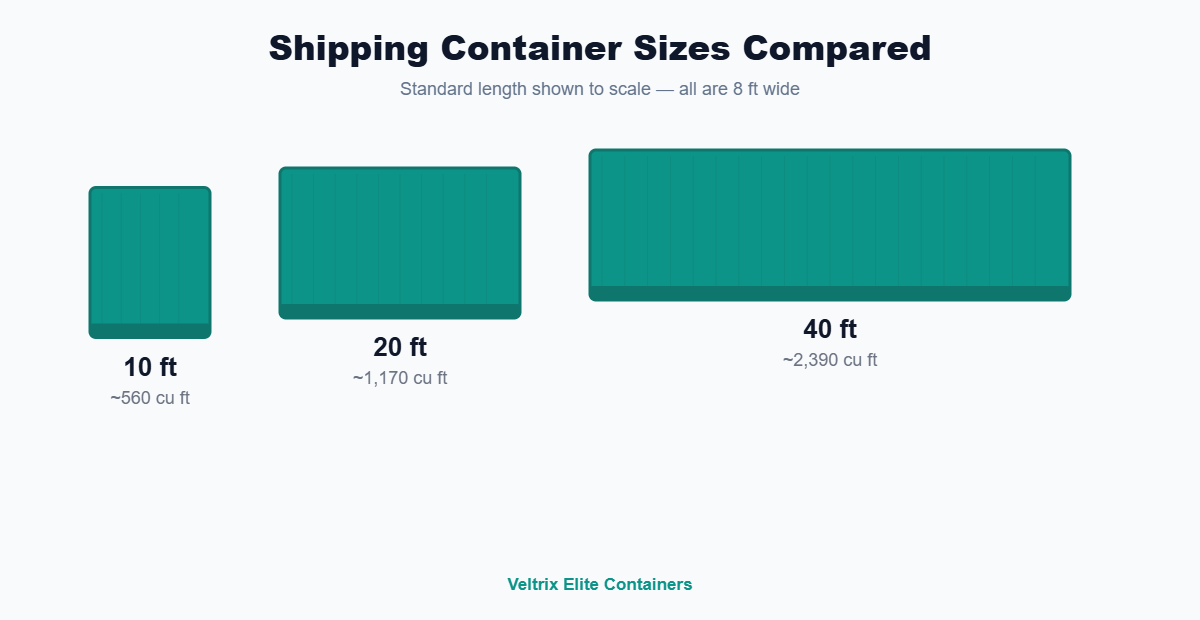
A 10ft container is the most compact standard option, ideal for small businesses, tight yards, residential storage, or as a base for a converted office or kiosk. It offers roughly 560 cubic feet of space and is easy to position where larger units won’t fit. Browse our 10ft containers.
20ft Shipping Containers
The 20ft container is the workhorse of the industry. It balances capacity and maneuverability, fits most delivery locations, and suits storage, shipping, and a huge range of conversions from offices to pop-up bars. With around 1,170 cubic feet of capacity, it’s the most popular single size we sell. Explore our 20ft containers.
40ft Shipping Containers
When you need maximum storage or freight capacity, a 40ft container roughly doubles the room of a 20ft while costing far less than two separate units. It’s the go-to for warehousing overflow, large equipment, and multi-room conversions. See our 40ft containers.
High Cube Containers
A high cube container adds an extra 12 inches of interior height, reaching 9ft 6in tall. That extra headroom matters for tall cargo, climate-controlled builds, or any conversion where comfortable standing space and insulation thickness count. Take a look at our high cube containers.
Specialty Sizes and Configurations
Beyond the standard lineup, we also stock less common sizes such as 15ft, 30ft, 45ft and 53ft containers, plus specialized configurations like double-door, open-top, and side-opening units. These are worth considering when a standard size almost fits, or when access and loading style matter as much as raw capacity.
How to Choose the Right Size
Start with what you’re storing or building, then think about your delivery site. Measure the access route and final placement area, because a freight truck needs room to maneuver and set the unit down. If you’re torn between two sizes, most buyers are happier sizing up slightly than running out of room later.
Ready to Find Your Container?
Browse our full range of shipping containers for sale, with a clear flat shipping rate so you know your costs up front.